
Rethinking Solar: Why Vertical Bifacial Panels like the Sunzaun Along Canals Could Be a Game-Changer
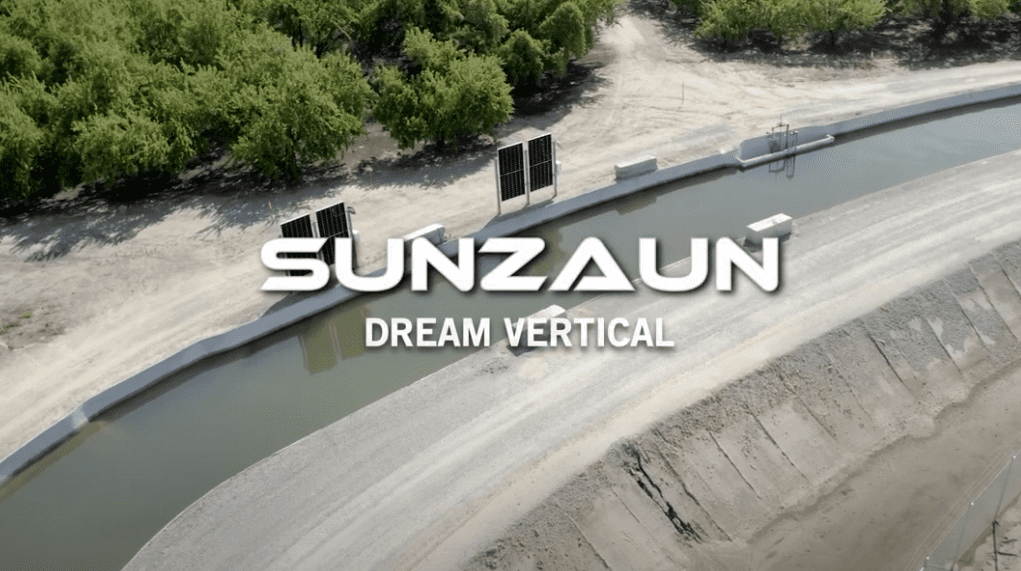
Solar energy systems are evolving — not just in what they’re made of, but in how and where they’re installed. One innovative approach gaining attention is the use of vertical bifacial solar panels placed along the sides of irrigation canals.
At Sunstall, we help bring such systems into reality with mounting and engineering solutions — and with our product Sunzaun, we offer a purpose-built vertical PV solution that’s ideal for these kinds of applications.
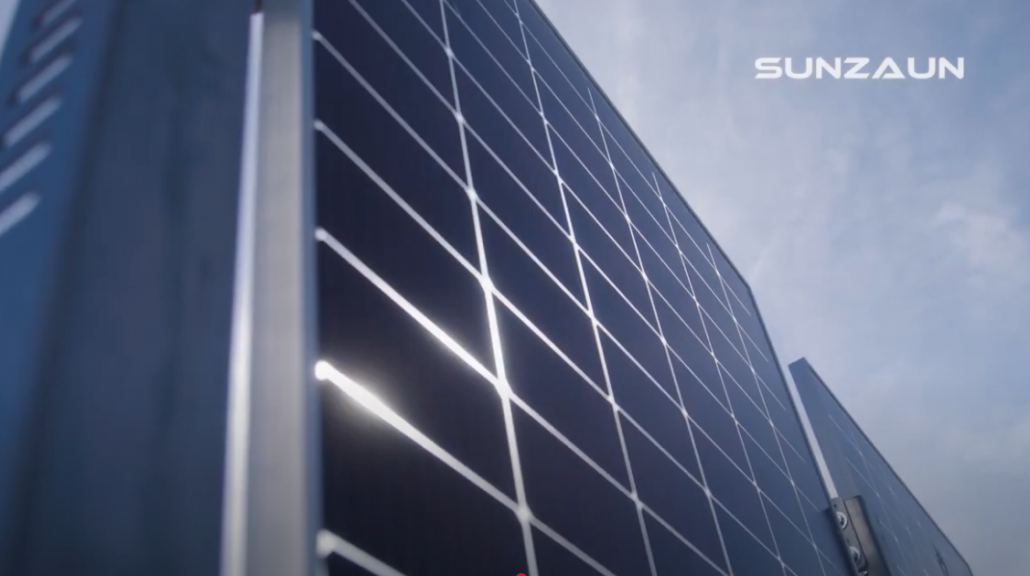
Vertical bifacial solar panels collect sunlight from both the front and back, allowing them to harness more energy throughout the day. But beyond the technology itself, it’s the placement strategy that makes this approach so impactful — and it’s where Sunzaun offers a clear advantage.
Why Go Vertical — and Why Along a Canal?
Traditional solar arrays are typically installed at a tilt (e.g., 20°) facing south. That works well — but it requires open land, is prone to dust accumulation, and creates steep seasonal production curves with big summer peaks and winter valleys.
In contrast, vertical bifacial systems like Sunzaun can:
- Collect light on both sides, especially when ground or nearby surfaces reflect sunlight
- Stay much cleaner in dusty environments — vertical orientation reduces soiling by up to 95% compared to tilted panels¹
- Perform better in winter months, leading to a flatter seasonal production profile — important for grid stability²
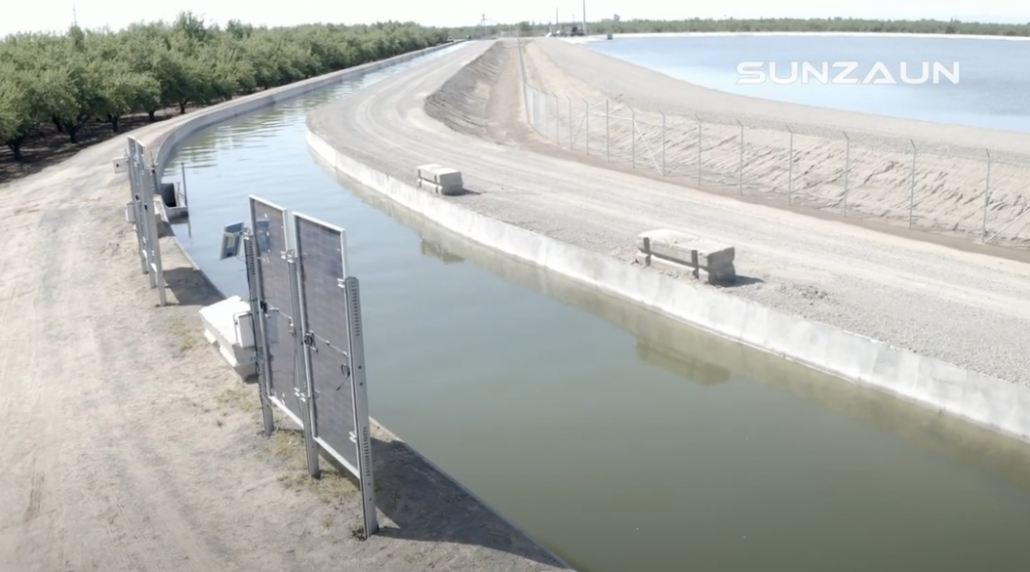
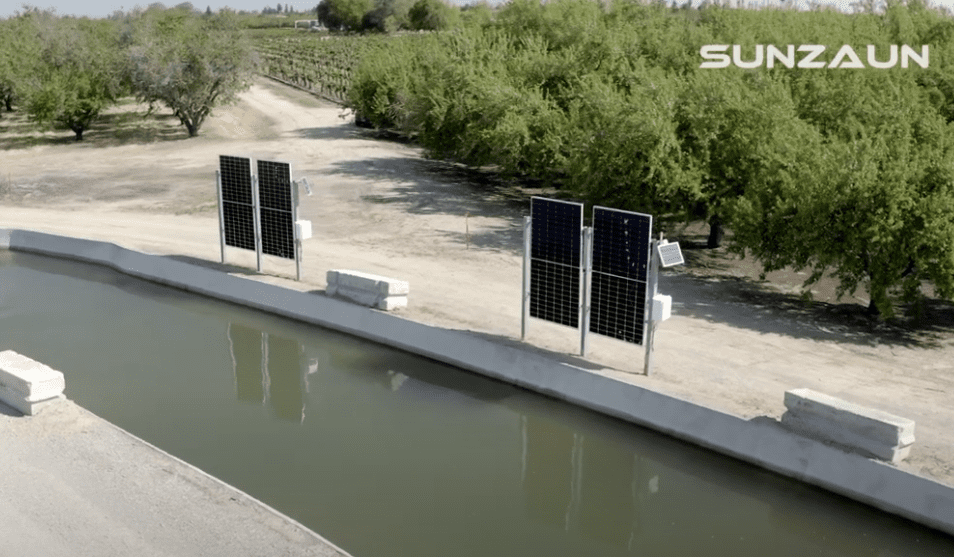
When placed along a single bank of a canal, these panels avoid the need for complex mounting over the water. That’s a key advantage in areas where canal access is limited — and where Sunzaun’s vertical, ground-mounted design fits naturally into narrow corridors and bank edges.
What About the Energy Output?
Modeling shows that a south-facing vertical bifacial array, without any reflector, can deliver about 87% of the annual energy of a standard south-facing 20° tilted monofacial array — but with superior winter performance².
Adding a simple reflective tarp across the canal (or part of it) can increase that output by another 19%–24%. If a hybrid reflector is used — combining a durable base with a shiny aluminized Mylar top layer — the boost can reach **41%–44%**³.
In addition, this setup helps to reduce evaporation from the canal by about 61%, thanks to shading and reduced wind-driven losses — a valuable bonus in water-stressed regions⁴.
To put that into perspective: saving 610,000 gallons per year (from a canal segment losing 1 million gallons annually) is equivalent to the annual water use of 9 to 22 Californians, depending on regional consumption habits⁵.
In agriculture, this amount of water could irrigate around 0.37 acres of rice or 0.63 acres of field crops, showing how solar canals help conserve both water and energy⁶.
Now scale that up: California has approximately 4,000 miles (6,400 km) of irrigation canals⁷. If similar systems were deployed along the entire canal network, they could save up to 63 billion gallons of water per year⁸ — enough to supply more than 2 million people annually, or to irrigate over 50,000 acres of farmland⁸.
Where and When Does It Make Sense?
This design is particularly well-suited to:
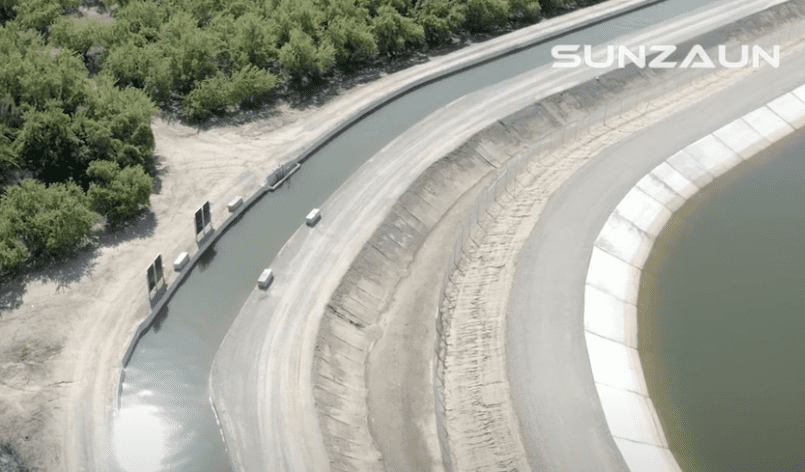
- North-south oriented canals less than 17 feet (5.2 m) wide⁴
- Dusty, high-soiling environments (e.g., California’s Central Valley)¹
- Locations where land availability is limited
- Projects where only one canal bank is accessible
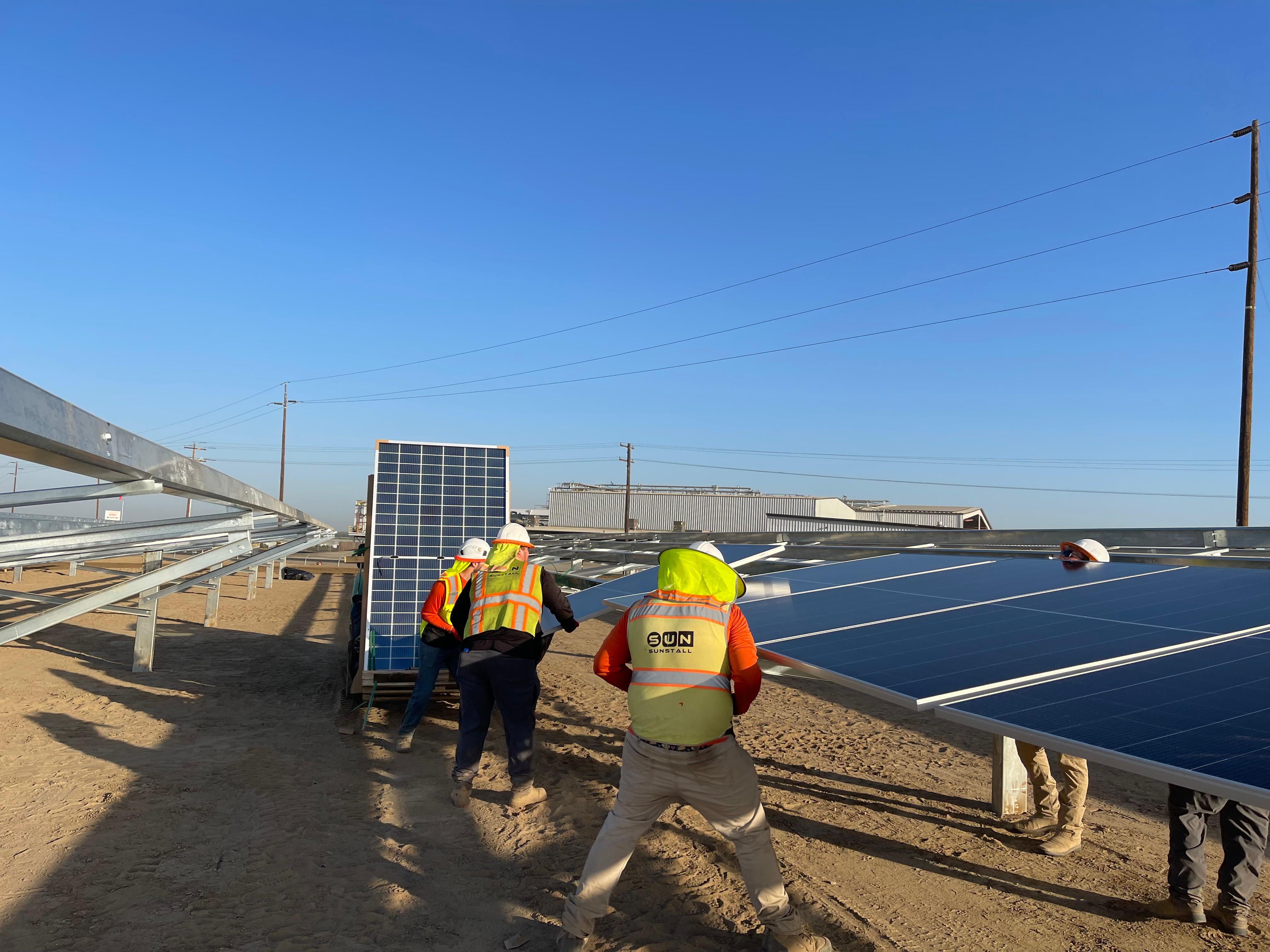
In these scenarios, vertical systems can be cost-competitive or even cheaper than traditional canopy systems — especially as structural and installation costs (e.g., steel, concrete) continue to rise. With Sunzaun, we offer a solution that is simple to install, low-maintenance, and ideal for linear infrastructure like canals and roadsides.
Modeling suggests that vertical systems could remain economically viable even on canals up to 25 feet wide, depending on material and labor costs⁴.
Conclusion
Sunzaun is more than a solar panel system — it’s a smart infrastructure solution for the real-world challenges of today’s energy and water systems. Vertical bifacial systems like Sunzaun offer a powerful alternative to conventional solar designs, especially for dual-use applications like canals.
They’re more space-efficient, resilient to dust, and better balanced across seasons. And when paired with a smart reflector design, they can rival — or even surpass — traditional systems in total output.
At Sunstall, we’re proud to offer Sunzaun as a proven product that makes all this possible.
Rethinking orientation and placement may be just as important as improving the panels themselves.
Sources
- Bhaduri & Kottantharayil, Soiling Analysis of Vertical PV, IEEE, 2019
https://ieeexplore.ieee.org/document/8887284 - Reagan & Kurtz, Energetic Comparison of Vertical Bifacial to Tilted Monofacial Solar, IEEE, 2022
https://ieeexplore.ieee.org/abstract/document/9924604 - Reagan et al., Material Selection and Cost Modeling for Reflectors in Vertical Canal PV Systems, IEEE, 2024
https://ieeexplore.ieee.org/abstract/document/10829584 - Field data from UC Merced Project Nexus and submitted PVSC 2025 paper (in review)
- Water usage per capita:
– USGS California Water Use Statistics
– Valley Water – Understanding Your Water Use
– Los Angeles Times – July 2024 Water Tracker - Agricultural water needs:
– UCANR Rice Irrigation Guide (PDF)
– Press Democrat – California Crops and Water Use - Smithsonian Magazine – California’s Solar Canal Pilot
- Los Angeles Times – Opinion: California’s Solar Canals Could Save Water and Generate Power


Leave a Reply
Want to join the discussion?Feel free to contribute!