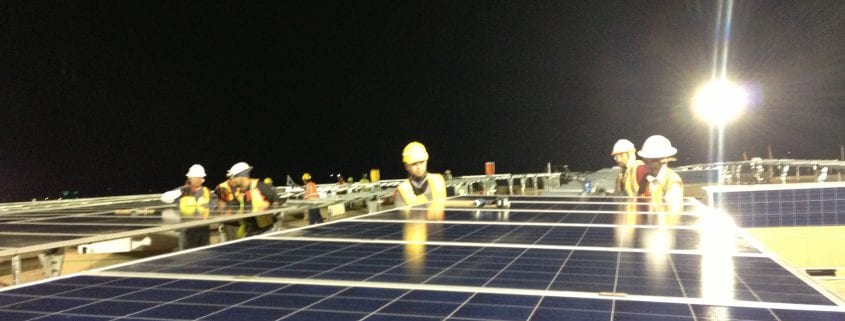
https://sunstall.com/wp-content/uploads/2016/12/IMG_5280.jpg15362048HBhttps://sunstall.com/wp-content/uploads/2016/02/Logo-Sunstall-website-3-e1457126621771.pngHB2016-12-08 23:13:292017-01-26 00:33:24Large PV Installs – Productivity is the kicker
As photovoltaic (PV) projects have evolved over time, the industry has focused on reducing costs to increase the adoption of solar power. This reduction has been dramatic, and the corresponding increase in solar PV projects is exciting, with new records in project size and overall deployments announced nearly every year. As solar project costs drop so, too, have racking costs through the utilization of improved engineering analysis, appropriate and efficient material selection, and improved manufacturing approaches. Knowing that racking continues to play an integral role in solar installations, savvy project integrators are paying more attention than ever to products and solutions available to reduce costs and create job site efficiencies. To help end-users optimize PV installations, the following breaks down the project development and construction process, from start to finish.
https://sunstall.com/wp-content/uploads/2015/04/sun-solar-panel.jpg8151446HBhttps://sunstall.com/wp-content/uploads/2016/02/Logo-Sunstall-website-3-e1457126621771.pngHB2015-04-29 17:58:302016-01-29 06:18:5810 Things to improve a Solar Ground-Mount Project
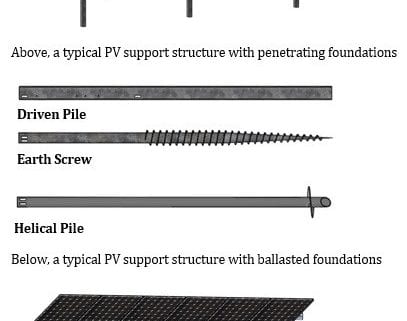
Foundation selection is critical for a cost effective installation of PV solar panel support structures.Lack of proper investigation of subsurface conditions can lead to selection of the wrong foundation type and can result in costly change orders and delays to the job completion date.
https://sunstall.com/wp-content/uploads/2015/04/whitepaper-images-jpg.jpg508407HBhttps://sunstall.com/wp-content/uploads/2016/02/Logo-Sunstall-website-3-e1457126621771.pngHB2015-04-22 18:29:052017-01-26 19:04:00White Paper: Foundation Selection For Ground Mounted PV Solar Systems
$1/Watt PV System – BoS /Installation Challenges for Ground Mounted Systems
The $1/watt White Paper from the U.S. Department of Energy was a great start to kickoff discussions and movements towards the goal of making solar power competitive without any incentives. To achieve this goal, the cost of an installed PV system would break down into the following components:
• $.50/watt for Modules
• $.40/watt for BoS/Installation
• $.10/watt for Power Electronics
Module Prices and Power Electronics are Getting There
With new production capacities going online almost every week and new players consistently entering the global market, it seems that the question is not if, but when the module prices will hit the $.50/watt. Innovation, scale of production and fierce competition will lead the way to the defined goal, not only for the modules, but also for power electronics.
BoS/Installation
Currently, physical system costs, including labor, are accounting for about 75% of BoS costs for a ground-mounted installation. These costs are divided between structural components and the electrical system.
How can these costs be driven down to the $.40/watt goal? A 2010 Rocky Mountain Institute (RMI) workshop suggested the following steps:
• Reduce forces at work – such as reduction of the wind load
https://sunstall.com/wp-content/uploads/2012/01/muda-1.gif299201HBhttps://sunstall.com/wp-content/uploads/2016/02/Logo-Sunstall-website-3-e1457126621771.pngHB2012-01-26 18:36:272017-01-26 00:15:59Toyota Production System (TPS) & $1/Watt PV System Challenge
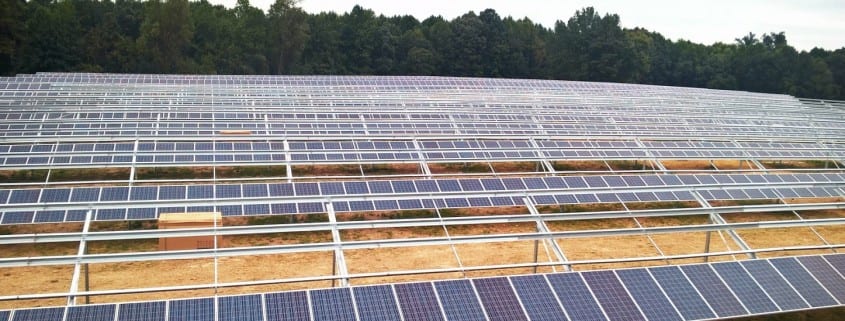
Ground-mounted systems are probably the simplest way to install solar on a larger scale compared to other types of installations such as roofs or parking structures. These systems can be held down by a variety of foundations, including concrete footings, pile driven posts, piers, metal earth screws or with ballasted holding trays.
One size fits all ?
Foundation systems need to correspond to the existing site considerations and soil static conditions according to engineering calculations and building codes. The one size fits all approach will not lead to the most cost and resource efficient results. Here are some key factors that will help to determine the foundation type:
Tilt angle and tracking characteristics of the solar power system.
Local design wind speeds and snow loads (If applicable) where the solar power system is to be installed.
Support and racking configuration.
Overall solar module system size and weight.
Local design codes and project requirements.
Soil characteristics relative to friction, sliding, consolidation, slope stability, salinity, etc.
https://sunstall.com/wp-content/uploads/2011/05/overview-foundation-types-sunstall.jpg129250HBhttps://sunstall.com/wp-content/uploads/2016/02/Logo-Sunstall-website-3-e1457126621771.pngHB2011-05-30 17:10:002017-01-26 00:04:02Foundations for Ground Mounted Solar Installations
We use cookies to ensure that we give you the best experience on our website. If you continue to use this site we will assume that you are happy with it.