Building for the Long Haul
Here’s the part that matters most: the payoff for getting this right doesn’t show up at commissioning. It shows up 10, 15, 20 years later.
A site installed with future adaptability in mind can absorb a capacity upgrade, a component swap, or a repair within its existing framework. A site where those considerations were skipped early on turns every future change into a disruption — more cost, more downtime, more complexity than it should ever have required.
Solar assets are expected to perform for a quarter century or more. That’s a long time to be living with decisions made in a matter of weeks during construction. The sites that hold up aren’t necessarily the ones built fastest — they’re the ones built with the discipline to still make sense a decade later.
The Real Differentiator Isn’t Speed
It’s tempting to treat installation as a construction-phase cost to be minimized — get it done, move on. But the facilities and industries getting this right are starting to treat their internal build quality as a long-life operational asset instead, worth the same care as any other capital investment.
Solar should think the same way. Predictable outcomes — consistent orchestration across pile driving, logistics, and module installation — aren’t just a way to hit a deadline. They’re what determines whether a site is still cheap to maintain, easy to expand, and reliable to operate two decades from now.
Speed gets a site built. Discipline is what keeps it running.
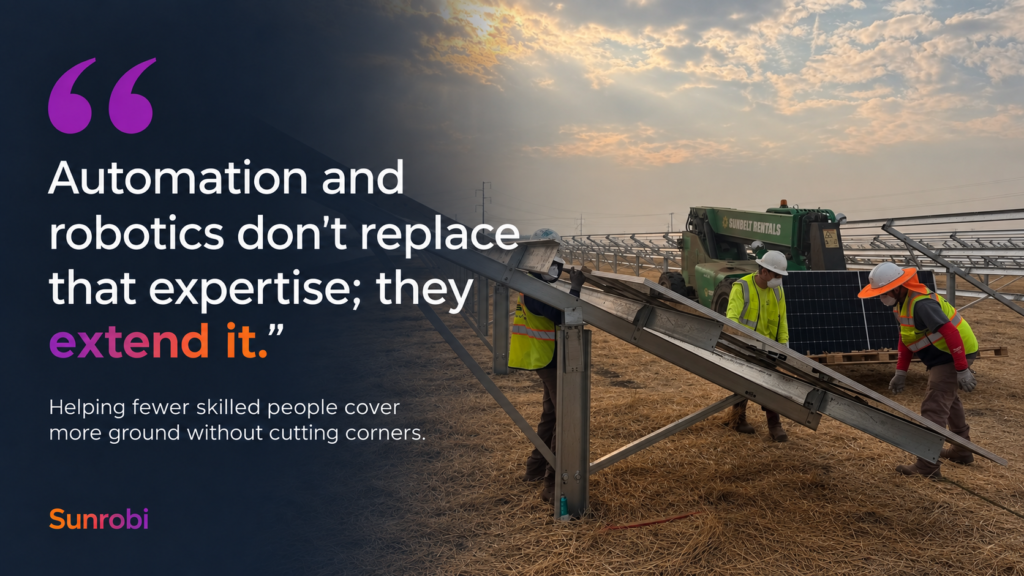
That’s the problem SunRobi is built to solve. By orchestrating pile driving, logistics, and module installation into one coordinated, predictable process, SunRobi helps developers and EPCs build sites that are fast to deploy and built to last — without trading one for the other.
If you’re planning your next site and want installation quality that still holds up in year 15, talk to the SunRobi team.


Leave a Reply
Want to join the discussion?Feel free to contribute!